
Orbital Data Centers
The new set of hot space companies

Orbital data center startups have been in the news in some big ways in the past month.
On May 11, Aetherflux rebranded to Cowboy Space Corporation, raised a $275 million Series B on a $2 billion valuation, and decided to get into the launch business. Index Ventures led the round, accompanied by new investors IVP, Blossom Capital, and SAIC, as well as existing investors Breakthrough Energy Ventures, Construct Capital, Andreessen Horowitz, NEA, Interlagos, and CEO Baiju Bhatt (who previously founded Robinhood).
Cowboy Space Corporation is planning to make the upper stage the data center payload, which could simplify the mechanical design of the spacecraft, and also provide a bit more mass to absorb heat.


This strikes me as a technically elegant approach; the R&D program for Rocket Lab’s Electron, which is probably the best successful example of a rocket design from scratch in this century, cost about $100 million.
On May 5, Aethero Space CEO Edward Ge announced on X that he was stepping down as CEO and transitioning to an advisory role. Aethero is working on the next generation of space data infrastructure, building high-performance computing for data processing and management in space. It also builds computing-focused satellite platforms across multiple form factors, and licenses software to support AI development.
I have no insight into what led to this decision and wish Edward the best, but a founder-CEO departure from a company that seems to be doing well in a hot sector is an event of some note.
SpaceX is exploring orbital data centers in the context of its upcoming IPO.
And Starcloud, a YC-backed space company whose valuation shot up to $1.1 billion just a year and a half after demo day, deployed an Nvidia H100 chip on a SpaceX rideshare mission in November 2025.
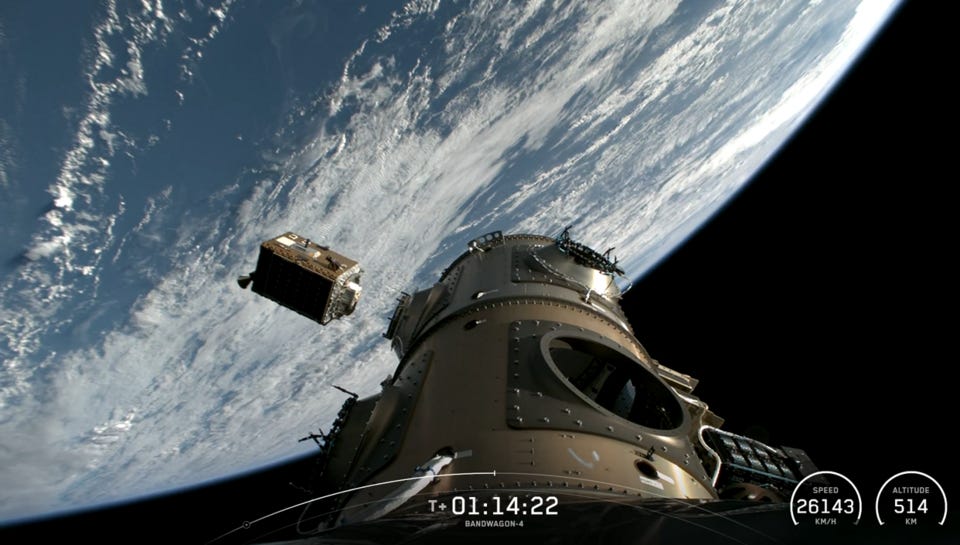
Orbital data centers are becoming increasingly attractive to capital, and increasingly in the news, so this week I’m going to share how I think about them.
Why Space?
There’s increasing demand for AI-oriented industrial computing capacity. AI populism is also making terrestrial data centers increasingly unpopular.

If companies can’t put data centers on land specifically because of power consumption concerns, there are basically two scalable options.
They can put data centers in the water, and they can put them in space. Both the maritime and space environments are incredibly hostile to man-made products:
Space is a vacuum, so it’s hard to dissipate heat; has radiation; is hard to reach for installation and maintenance; is hard to reach for communications.
The ocean is saltwater, which is corrosive; is subject to weather; is hard to reach for installation and maintenance; is hard to reach for communications.
To a first-order approximation, space is probably the better place to put data centers with a life expectancy < 5 years because power generation is a solved problem.
I know there are multiple companies working on maritime data centers, and they may actually be better on the technical merits over the long term, but let’s ignore that for the rest of this post.
I write Molding Moonshots in a personal capacity.
If you are building in deep tech and thinking about raising Pre-seed, Seed, or Series A funding, I’d be more than happy to have a chat on professional terms, as an investor at MFV Partners!
Send me an email and we’ll find a time.
Splitting the Market
In my mind, there are two good reasons to run a server in space:
Somebody needs to analyze data generated in space
Somebody needs to analyze data generated on Earth
The first reason I expect will eventually be very economically compelling, but it is farther out in the future.
All the orbital data center applications I’ve seen today fall within the second category.
What exactly are we running up there?
The next step in evaluating the business case has to be locking down what the service actually is.
Right now, we’re thinking about AI training and inference jobs that originate on Earth, and that terrestrial data centers lack capacity to handle.
Running the compute jobs in space has, in my mind, five separate elements:
transferring the data from the customer to the ground station
transferring the data from the ground station to the satellite
running the compute job on the satellite
transferring the data from the satellite to the ground station
transferring the data from the ground station to the customer
Elements 1 and 5 are essentially solved problems; this should look basically identical to what Internet Service Providers do on a day-to-day basis.
Element 3 is fundamentally a question of satellite design. Back in January, Casey Handmer, one of the best technical bloggers of our generation, published a great piece about DC Data Centers. His thesis was that AI economics are basically destined to run on solar and DC batteries. I’m not sure I’m convinced yet, but his claims are plausible enough that his key assumption is worth debating:
Fundamentally this is a bet that GPUs are so valuable on a per gram basis that even launching them to space helps improve the economic utility of a Watt of solar power.
Casey’s not an Elon bro; he is up front about what he sees as the costs of this approach. He identifies them: launch costs, lack of ability to do maintenance, latency (he assesses this as 50ms in the worst case), effects of radiation on computing, and the misery of thermal engineers trying to cool a computer in a vacuum.
Elements 2 and 4 are where the problem is, and where I think Casey’s analysis is potentially incomplete.
Casey assumes 50ms latency, which is a reasonable assumption for time on the RF communications network to get from a ground server to a satellite, or vice versa. However, that doesn’t take into account the time needed for the satellite to come into view of a ground station which has time to communicate with the satellite.
Most satellite operators today don’t run a world-wide network of ground stations or maintain constellations with inter-satellite links. The satellite has to pass in the field of view of a ground station in order to communicate with the ground, and that can take time. SpaceX’s Starlink V2 satellites do have these links, but ground station availability is still not a guarantee unless it’s brought in-house.
That means space-based data center operators will still need access to lots of real estate around the world to be effective.
The other thing this runs up against is that radio spectrum is one of the few regulated and truly finite resources out there.
This is a problem by itself given how popular an advocate might expect space-based data centers to be. But it’s actually worse than that. RF communications technologies have a larger footprint on Earth than alternatives like optical communications technologies, as shown in the exaggerated example below.

That constrains the data throughput of RF systems. Optical systems would allow more data throughput and create less interference, but they have different engineering challenges for the satellite itself in element 3.
Large deployable structures in space like some types of radiators, which everybody agrees would be necessary to run a large data center in orbit, create what engineers call “flutter”. Flutter is a sort of self-excited oscillation whose amplitude grows over time, and can eventually cause catastrophic structural failure.
Even if the vehicle isn’t lost, flutter is going to adversely impact the satellite’s ability to precisely orient itself, which is critical to optical communications. Because optical communications subsystems have smaller footprints, they require much more precise and stable pointing during transmission and reception windows than RF communications architectures.
To be clear, I’m not saying these second-order effects are unsolvable, but rather that the bottleneck and key constraint is data throughput, and data is also what makes the whole concept of operations economically useful.
While data is not a physical product, data’s wireless transmission is regulated with comparable rigor. Furthermore, its wireless transmission is even more constrained by the laws of physics than the return of any sort of drug, or silicon chip, or metamaterial that gets manufactured in space.
In other words, data centers in space make data a special case of space resource.

Where do we go from here?
If this is inevitable, there’s got to be an edge in solving the underlying technical problems, which Vik’s Newsletter earlier today spoke to from a chips-first point of view.


I particularly appreciated his callout of the TBIRD payload, whose satellite bus I worked on at Terran Orbital.
But the more important point he makes is his identification of the core issues from a chip-first perspective, and his description of them as markets.
There’s one school of thought that orbital data centers are going to vertically integrate, which is that’s historically pretty rare in aerospace. There’s also a very real possibility that certain subsystems of the mission-specific satellite architecture could become focus areas for different firms — and this industry structure is more similar to my understanding of how the chip sector works.
I’m not convinced that the only value to be gained in orbital data centers is at the scale of the space vehicle.