
Voyager bought Astrobotic
Linking LEO and Lunar Landers

SpaceX, the undisputed winner of the launch industry over the past twenty years, is characterized by two things.
First is its growth through extreme vertical integration. The same firm designs the structures, manufactures the engines, integrates the rocket, operates it, and performs maintenance on it. It has also become its own biggest customer through the Starlink internet service.
Second is its CEO Elon Musk, who is probably the best fundraiser of our generation.
But there is another way of growing a large space company, and it’s worth talking about in the context of some startup exit news. Last week, Voyager Technologies completed its acquisition of Astrobotic.
Voyager Technologies
What does it do?
Voyager Technologies builds mission-critical defense and space systems. The firm was founded in 2019 by CEO Dylan Taylor.
It’s difficult to be both particular and brief about its offerings because the list of services and goods includes nearly twenty types of offerings across the space, cyber, air, and land domains. This includes everything from RF spectrum management solutions and laser communications equipment, to smoke detectors, chemicals, and rocket motors.
The firm is also the majority owner of Starlab, a joint venture with Airbus (European Union), Mitsubishi (Japan), and MDA Space (Canada) to build and operate a space station in Low Earth Orbit (LEO).
The firm mostly engages in government work, and it serves as both a prime contractor and a subcontractor.
It maintains a subsidiary to provide overhead support like accounting and proposal writing to its holdings, as well as a subsidiary to hold IP.
I write Molding Moonshots in a personal capacity.
If you are building in deep tech and thinking about raising Pre-seed, Seed, or Series A funding, I’d be more than happy to have a chat on professional terms, as an investor at MFV Partners!
Send me an email and we’ll find a time.
Technical Progress
Due to the incredibly broad portfolio of offerings, different products have different levels of technical maturity.
For example, its Acceleration Measurement System has 11 years of flight heritage in its intended operational environment, which is as mature as technology gets. Starlab is still in development, and completed its Critical Design Review earlier this year.
Some offerings defy placement on a spectrum. Custom power electronics don’t fit this mold at all. The whole value proposition is that they are custom—so they can’t have flight heritage. Similarly, the services offerings aren’t so much characterized by their maturity as much as the teams’ expertise—and we don’t really have insight into that one way or another.
Fundraising History
The firm went through an IPO that raised $402M in June 2025. Here’s its most recent Form 10-K.
Interestingly, this seems to have been a delayed event; an executive said in July 2020 that the firm was planning to go public within the next couple years. It’s not clear whether the core cause of this was the COVID-19 pandemic, the “Great Space SPAC Meltdown”, or something else.
The company’s early capital strategy has been difficult to trace. At least some early financing events are recorded on the company’s investor relations page and seem to have been filed pursuant to Rule 506(b) of Regulation D, but these are not by themselves useful since they are filed at the beginning of a raise and don’t specify the buyers of the securities.
Pre-IPO investors included Razor Capital, NewSpace Capital, Midway Venture Partners and Industrious Ventures.
A note on the CEO
Dylan Taylor is the founder, Chairman, and CEO of Voyager Technologies. He controls the majority of the firm’s voting shares. He’s also the most prolific angel investor in the space sector, at least that I’m tracking. Taylor has invested in more than 50 startups, including York (IPO), Planet (SPAC), Relativity, LeoLabs, Orbit Fab, and Astrobotic.
I’m not prepared to claim that Taylor is the best investor of our generation overall, but he probably is the best angel investor of our generation in the space sector.
This seems to have affected Voyager’s strategy, at least in the macro sense of understanding when lots of startups would be looking to exit and developing something approaching proprietary dealflow.
Acquisition History
Due to the structure of the firm as a holding company, and the CEO’s history as an angel investor, this firm’s fundraising history can only really be understood in the context of its acquisitions:
Astrobotic (July 2026)
Estes Energetics (November 2025)
ExoTerra (October 2025)
BridgeComm (September 2025)
ElectroMagnetic Systems Inc. (August 2025)
LEOcloud (April 2025)
ZIN Technologies (March 2023)
Space Micro (January 2022)
Valley Tech Systems (October 2021)
Nanoracks (May 2021)
The Launch Company (April 2021)
Pioneer Astronautics (July 2020)
Altius Space Machines (January 2020)
The Form 10-K also mentions minority investments in Max Space and Plan Z Capital.
Astrobotic
What does it do?
Astrobotic is a Pittsburgh-based company started in 2007 that builds lunar landers, rovers, and associated equipment. It’s a spinout of Carnegie Mellon University, founded by faculty in order to win the Google Lunar X Prize.
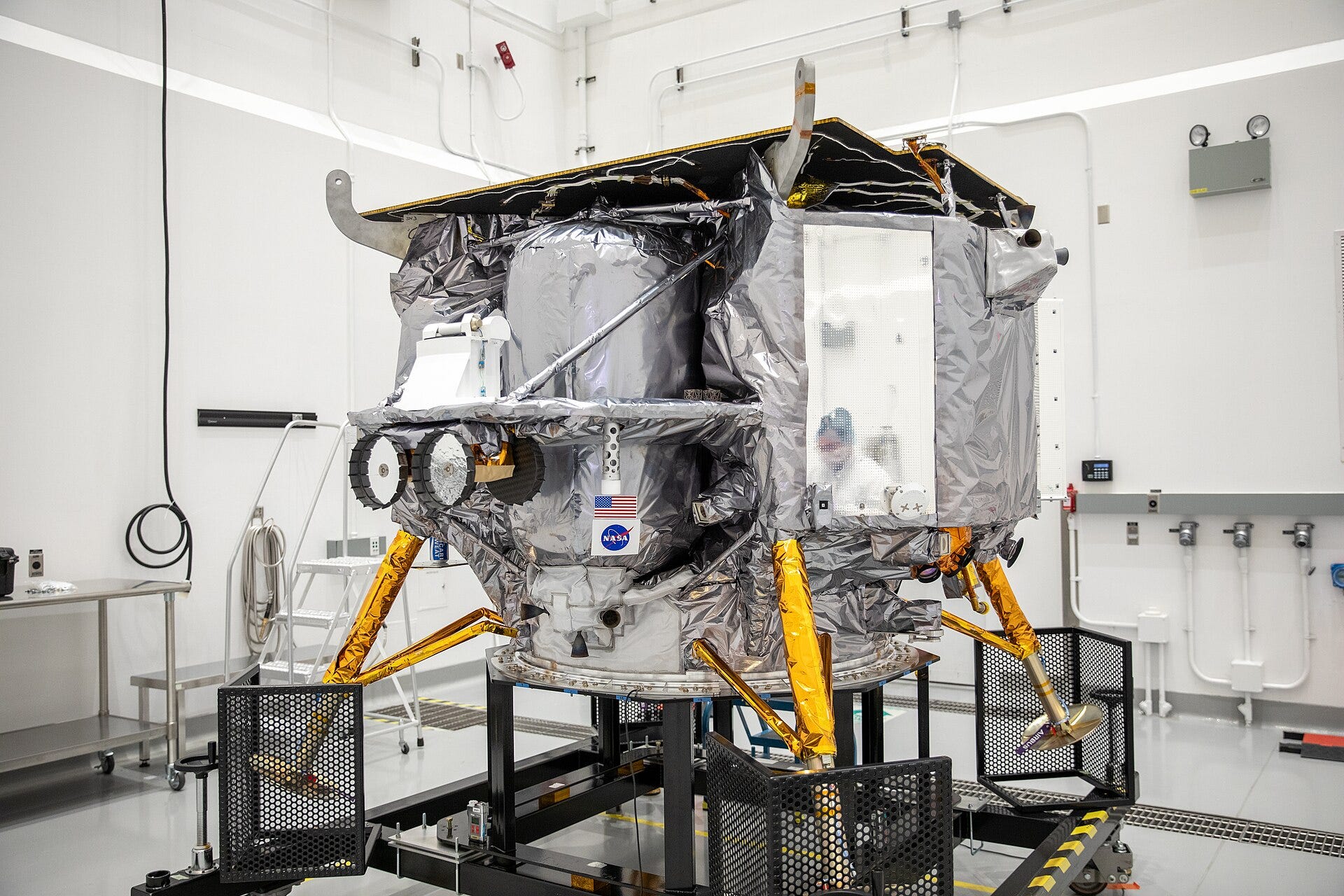
The first lander architecture is called Peregrine. It has a design payload capacity of about 260kg/580lbs to the lunar surface, though the first mission had a payload mass of 90kg/200lbs. It stands less than 2m tall. It is not designed to survive lunar night, limiting early mission durations to less than 14 days.
Griffin is its successor, and is designed to carry larger and more complex payloads—like lunar rovers. It has a payload capacity of 625kg/1377lbs to the lunar surface.
Technical Progress
Astrobotic launched its first Peregrine lander on January 8, 2024.

.jpg)
The company eventually revealed that shortly after the spacecraft separated from its launch vehicle, a Helium valve did not actuate properly, rupturing the connected propellant tank. The spacecraft travelled through cislunar space for about a week before mission ended with reentry on January 18.
Griffin is scheduled to launch no earlier than November 2026. One of the payloads on this is supposed to be an Astrobotic lunar rover.
Fundraising History
Between its founding and 2026, Astrobotic won more than $600M in contracts from NASA and Department of Defense.
In 2016, the firm raised a $2.5M seed round from Space Angels, which has since been absorbed by the parent brand of Space Capital.
Dylan Taylor also seems to have made an investment, though the terms and date are not clear.
Acquisition Analysis
Technical Perspective
From Voyager’s perspective, Astrobotic expands the firm’s services offerings to new regions of space. Voyager has a whole host of services related to hosted payloads and deployable payloads, and it sells subsystems (batteries, motors, computers, etc) that enable operations beyond LEO.
Astrobotic provides the hardware and know-how to extend those payload services offerings to cislunar space, and potentially the lunar surface as well. Astrobotic could potentially provide payload services at the system level, or its IP and facilities could be applied to produce subsystem- and component-level products that it designed in house, or that other entities under the Voyager logo designed.
From Astrobotic’s perspective, this might unlock access to new components from brands under the Voyager umbrella, but it’s not clear to me that this is necessary to execute the firm’s plan. I think the technical benefits in this deal accrue overwhelmingly to Voyager.
On a broader level, what this demonstrates is that lunar operations can fit into publicly traded space companies as part of a technology portfolio. Intuitive Machines, which also builds lunar landers, acquired Lanteris (formerly Maxar), which builds large satellite buses for a variety of applications. This isn’t restricted to smaller and newer companies; we see similar behavior at SpaceX and Blue Origin, which are developing lunar landers as part of the Artemis Program and also have more mature launch vehicle and satellite programs.
Financial Perspective
If SpaceX is the demonstrated master of vertical integration, Voyager Space Holdings is making a play to be a horizontally integrated space company. This makes sense given the CEO’s track record as potentially the best angel investor in the sector.
$162M in cash and stock
$9M in assumed debt
$129M in earnouts contingent on performance milestones
So the target here is worth about $171M if the technology doesn’t quite work as advertised, and as much as $300M if it does.
Astrobotic also comes with substantial government contracts that Voyager intends to continue. Since Voyager’s most recent Form 10-K includes a Comprehensive Loss, this could be important at the holding company level.
If I value Voyager’s stock the same as cash (I don’t, it’s worth less as a loss-making firm) and I think all of the $600M in contracts will be recognized as revenue in the future (but hasn’t been yet), then Astrobotic was sold for 28-50% of its total government contracts.
That seems…really cheap for government contracting?
Major government contractors like Lockheed, Northrop, BAE, and RTX, which are admittedly much bigger firms, have Next Twelve Months Price/Earnings ratios well over 10x.
We don’t know the duration of Astrobotic’s $600M contracts, or how much has already been paid out, but it’s got me wondering what sort of discount rate Voyager’s agents used in their Discounted Cash Flow analysis.
From Voyager’s point of view, this looks like a cheap way to bring in more government contracts and expand its Total Addressable Market quite literally to the Moon.
From Astrobotic’s perspective, this is a strategic exit—a sale to another industry player rather than a financial investor like a buyout firm. A key effect of the transaction is to give the company the ability to raise more cash from the public markets if it needs to in the future, which may be necessary in order to execute NASA contracts. This is also probably the type of exit that had the highest likelihood of closing.
The financial outcomes of the transaction are more clearly mutually beneficial for both parties.
Minority investment