
Media Review: Yield
Google as a B2B Behemoth

This is the third in a series of three media reviews about the history of the internet.
Last month TechCrunch reported something that lots of people had been anticipating for a while now: a massive change to users see Google Search outputs, driven by AI. This seems to have been somewhat inevitable, given Google’s strategy for delivering AI to consumers and businesses. In fact, it is part of a pattern. Earlier this week, the firm cut its entry level AI pricing.
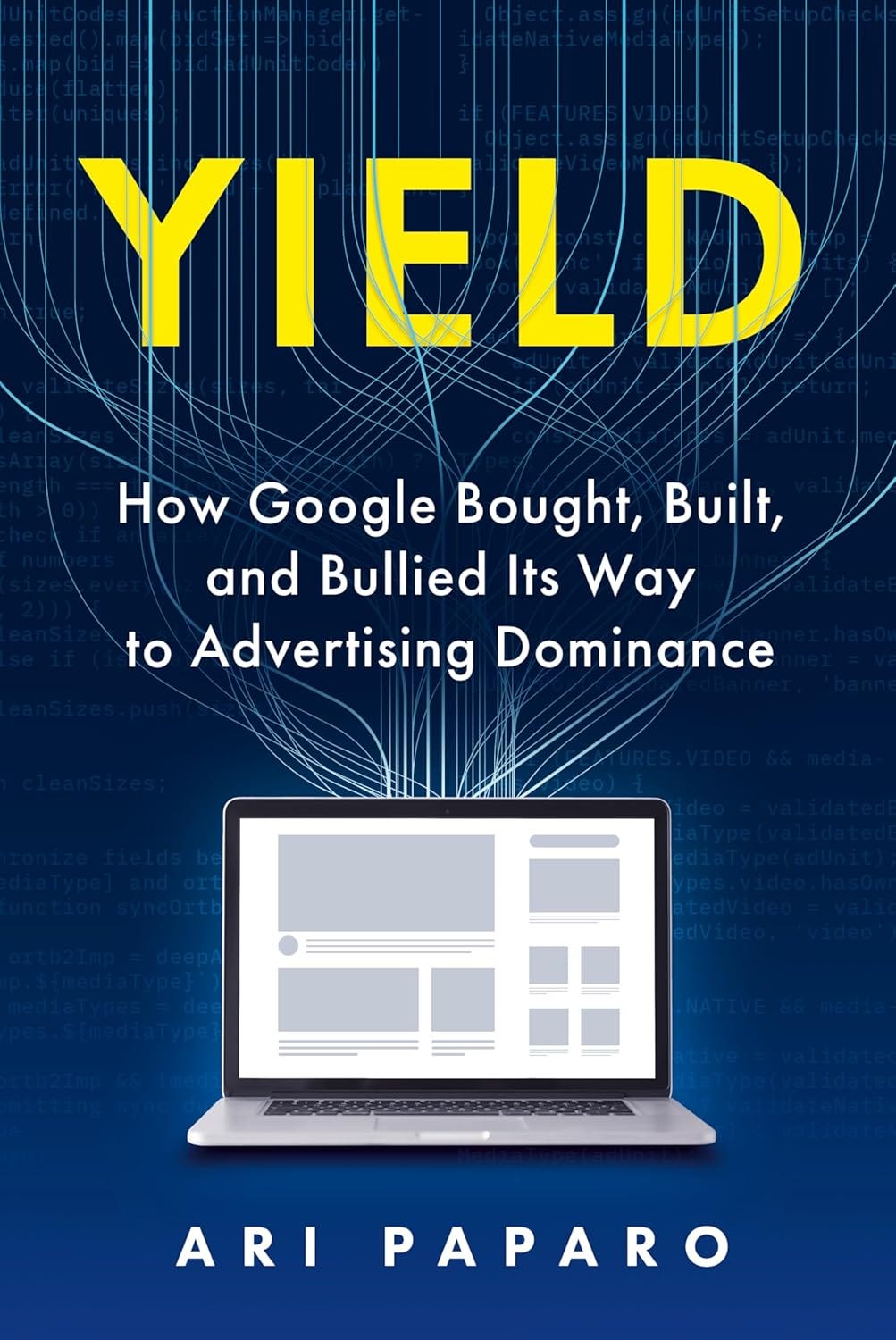
It’s also caused me to be more interested in the role Google plays in the internet among both consumers and businesses. So I decided to wrap up my series on the development of the internet with a book about the company. This week, I’m reviewing Yield: How Bought, Built, and Bullied Its Way to Advertising Dominance by Ari Paparo.
Content
This book is about how Google became the dominant player in advertising online, and how institutions and individuals adjacent to that position have reacted to it.
The first few chapters talk about advertising technology startups in the heady days of the dotcom boom. They also introduce readers to the structure of the legacy advertising industry, whose disruption is really the focus of the book.
The bulk of the text is concerned with how Google drove revenue from advertising from the early 2000s through COVID-19. This took three forms, and it’s not really possible to isolate them into phases where one was dominant.
First, there was a good deal of merger and acquisition activity, where Google simply bought competitive companies or divisions. The firm’s most famous acquisition from a modern consumer’s perspective is probably YouTube, but from the advertising point of view it is likely DoubleClick.
Second, the book speaks on a very basic level to market design in advertising auctions. Google applied concepts in these fields in order to financially engineer, across a very large number of very small transactions, more revenue. The most intense of these was Project Bernanke, through which Google essentially dropped its bids on ad slots in order to pay publishers less and utilize the difference to help its ad clients win auctions on its ad exchange (marketplace) over advertisers with different advertising purchasing platforms.
Finally, the book does discuss Google’s approaches to product improvements for different market participants. The most popular example of this was cookies, though there were many others. This was important in how I thought about the company, because it showed that at least sometimes, Google really was trying to make everybody better off—even if, by the mid 2010s, it was no longer living up to its catchphrase “don’t be evil”.
The emphasis on these last two growth mechanisms shows two things very well how Google’s core competency is engineering.
The end of the book steps back a bit. More attention is paid to how the advertising and journalism industries have responded to Google’s rise to power, as well as attempts by governments around the world to bring the firm to heel through judicial and regulatory mechanisms. This process is acknowledged as ongoing as of the completion of the manuscript.
I write Molding Moonshots in a personal capacity.
If you are building in deep tech and thinking about raising Pre-seed, Seed, or Series A funding, I’d be more than happy to have a chat on professional terms, as an investor at MFV Partners!
Send me an email and we’ll find a time.
Organization
The book is organized into four parts and twenty-six chapters. The chapters are generally quite short—most are well under 20 pages. Each one felt almost like a self-contained essay, which made the book easy to read across multiple settings. The first few paragraphs of each chapter felt almost like the start of an HBS case, but that’s not necessarily a bad thing; the syntax is clear, as is the structure. Furthermore, it contextualizes the broader industry narrative by zooming out from the perspective of a person in the sector on the cusp of a critical decision.
The narrative structure is mostly, but not strictly, chronological. The order of events here is slightly confusing and cuts across a lot of firms, but that’s not really avoidable in the scope of a broad topic like “Google’s role in internet advertising”. The author did something really smart here got ahead of it with a timeline in the beginning.
This book is structured not just to tell the story of Google’s rise in internet advertising, but also to explain to the consumer how internet advertising worked at least in the pre-GenAI era. In addition to the timeline:
The glossary appeared at the front of the book, rather than the back
There are four pages of diagrams demonstrating the various market structures discussed in the text
I thought this was great, and it helped me understand the market transformations that the book is really about.
Syntopical Reading
In the same sense that Cult of the Dead Cow charted the countercultural development of the internet, and How the Internet Became Commercial covered the commercialization of the internet, then Yield is really about the monetization of the internet—at the level of the individual web surfer.
Furthermore, it shows a level of centralization that was missing from the first two books. The first two books show that through at least the early 2000s, the internet actively pursued decentralized governance and collective decision-making, even in its corporate structures. Incidentally, that’s where the plot of Yield really takes off.
This book is really the story of how Google pursued a different strategy, of centralizing advertising monetization as much as it practically could. The firm was incredibly successful at this, to the point where the climax of the book is a number of antitrust lawsuits. Google got so good at centralization that multiple different government agencies felt it was not just a monopolist, but a bad monopolist that abused its position in its market.

The other thing this book illustrates, much more clearly than the other books in this review sequence, is how this new sort of advertising technology became very clearly not-deep tech. At the beginning of the narrative, startups were succeeding or not based on differentiated technical characteristics. There was still a need to market the services, but a company with unique and better engineering had a real shot at becoming the leader in its niche. By the time the antitrust lawsuits developed during the pandemic era, it was very clear that winning in this space was a function not just of what the participant’s current position in the market was, but also of what their role in the custom market was. The deciding factor in a company’s role in the market stopped being novel engineering, and started being market design.
Turning to more general topics of VC investment, antitrust enforcement has a material impact on VC investment decisions. In particular, less enforcement drives less investment—particularly in more concentrated industries. But this effect appears to be less pronounced in more innovative startups.
Final Thoughts
Self-promotion beyond my social circles doesn’t come intuitively to me. Consequently, neither does advertising or marketing as a field. I find I still have an engineer’s tendency to want the data, or the results, to speak for itself. So perhaps I shouldn’t be surprised that this book about the recent history of advertising online also wasn’t a natural fit or a particularly easy read for me. That’s not to say it’s poorly written, or boring, or about an unimportant topic—it is none of those things. But I don’t find the topic interesting for its own sake.
.JPG)
Having said that, the book was worth reading because it presents some great reasons to care about advertising for the sake of companies I invest in! Taking a step back to think about how I engage with the internet today as a user, it also helped me understand why advertisements on websites exist in their present form.
I think people working in advertising should read this book. Certainly people who are considering buying Google stock should read it—there’s meaningful insights into the firm’s culture.
I look forward to my next review being about something more…directly related to deep tech.
This concludes the series of three media reviews about the history of the internet.