
Media Review: Quantum 2.0
A Qualitative Intro to Quantum Phenomena

This week I’m reviewing Quantum 2.0: The Weird Physics Driving a New Technology Revolution, by Paul Davies.
I’ve been asking around for a good textbook on quantum computing for a while now. I have yet to find one. That strikes me as a problem because quantum computing is a growing segment of the deep tech economy.
Several firms that have gone through IPOs and SPACs in the past few years are pursuing differentiated technological approaches. These public market participants, and their startup competitors, are in a race towards quantum supremacy—a future in which a programmable quantum computer can solve problems that classical computers cannot feasibly solve.
I suppose the definitive textbook on the field won’t be written until a firm conclusively wins the race, but it’s wild to me that there’s no generally accepted great introduction to the field in book form yet. So going forward, when I see a book that looks interesting on quantum technologies, I’m going to start reading it—and if it’s worthwhile I’ll add it to my review queue.
Content
Davies starts his story of quantum technology at the beginning, with experimentation into the nature of the atom. I value this contextualization of the quantum sector’s project within the basic physics research and key physicists of the early 1900s because it illustrates how the theories developed over time. The historical narrative as presented also shows the enormous gap between the development of a theory and the development of the technology needed to prove or disprove the theory. Descriptions of proposed and executed experiments are a frequent topic throughout the text.
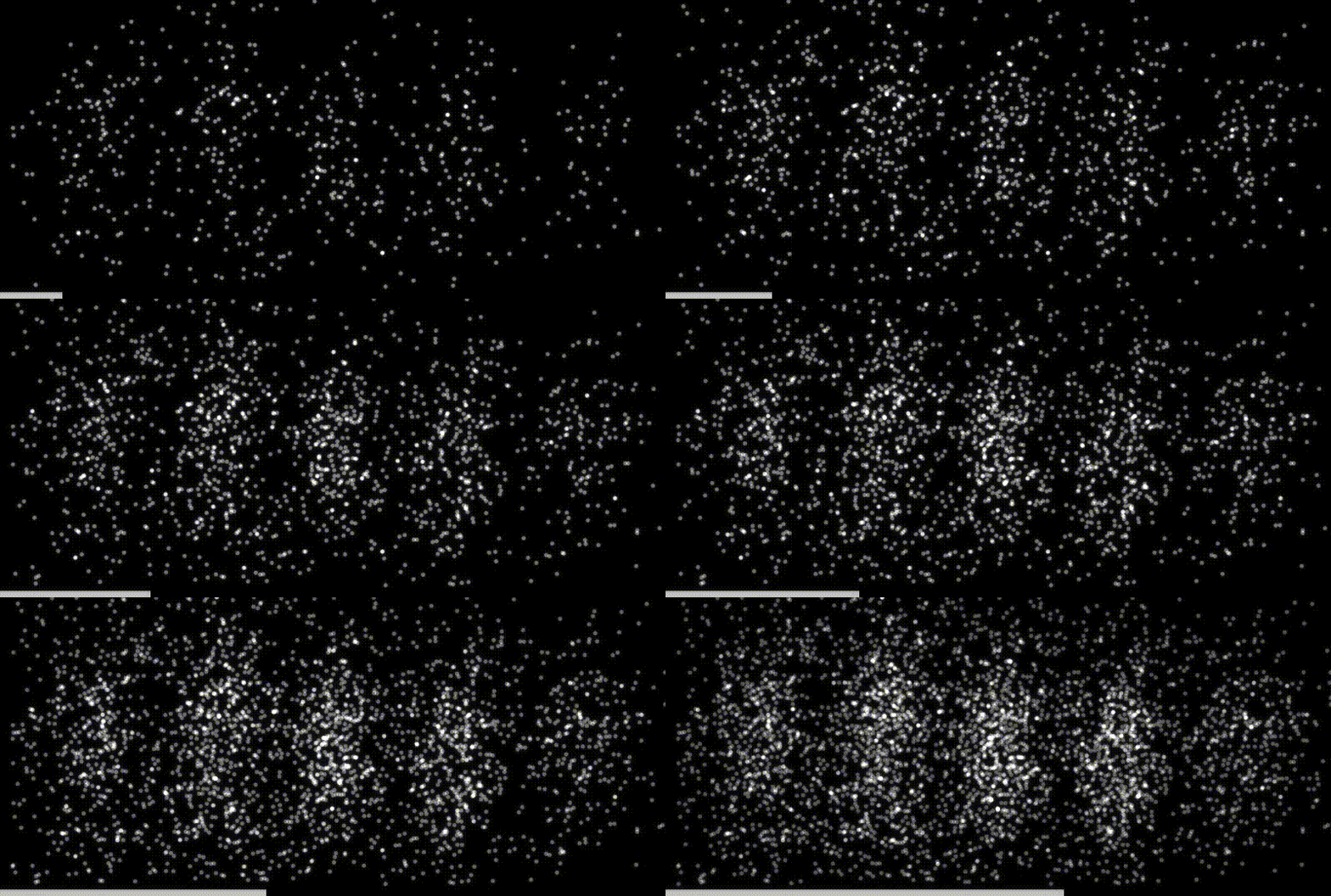
By the mid-1900s, quantum mechanics had a number of core principles. These are worth listing explicitly, both because the rest of the book is about their applications, and because several tie in to other fields:
Measurable physical quantities don’t have well-defined values until measurement
Measuring something in the quantum realm reduces it to a classical value, so it affects the system
Some things behave like both waves and particles
Non-determinism—the same concept as in LLMs
Specific mathematical concepts, which the book presents in an equationless manner
Superposition says multiple wave functions can be combined together, just like functions in math class
Entanglement says that one function may describe multiple particles simultaneously — this is what Einstein called “spooky”
Of course, Schrödinger’s cat made an appearance—twice.

The book is rooted in history, but largely looks towards the future. It invites readers to consider how quantum mechanics has enabled our lives to reach this point, and almost demands that we wonder how harnessing subatomic phenomena in the future might make them even better.
I enjoyed the chapter on quantum information science immensely, and was thoroughly impressed by the description of quantum cryptography. Only after reading this book do I feel like I’m starting to get a handle on why quantum key distribution matters.
The chapter on quantum sensing was also great. I was particularly intrigued by the concept of quantum radar, and mean to do some further reading on the topic.
The portions of the text about space and biology were the least interesting to me. I care about theories explaining origins of the universe, and stellar fusion, and black holes—but in the sense of intellectual interest, not a pressing need to understand how they might change the world today. It was just as well-written as everything else, it just wasn’t as urgent to me.
Towards the end, the author got philosophical about what it all might mean. I appreciated this. Science functions to explain how the world works, but it’s useful for scientists to be able to share their view on why it matters to non-scientists in a coherent way.
This is ultimately an introduction to the quantum universe almost exclusively through the lens of the history of science, which is a unique approach to writing about quantum phenomena, at least among books I’ve read on the topic. But this isn’t a book about quantum computing—it’s really about the natural and artificial phenomena the author understands as tied to quantum mechanics.
I write Molding Moonshots in a personal capacity.
If you are building in deep tech and thinking about raising Pre-seed, Seed, or Series A funding, I’d be more than happy to have a chat on professional terms, as an investor at MFV Partners!
Send me an email and we’ll find a time.
Organization
The book is divided into four parts, containing a total of eleven chapters. It’s about 270 pages long.
Part One: Paradigm Shift contains four chapters about “Quantum 1.0”, or the development of quantum phenomena through interactions between scientists including Bohr, Einstein, Feynman, and Schrödinger.
Part Two: New Technological Marvels, contains three chapters about potential or real applications of quantum mechanics that could impact our lives—from information science to timekeeping to photosynthesis.
Part Three: Cosmic Speculations, contains two chapters about what quantum mechanics has to say about astrophysics and cosmology.
Part Four: Philosophical Finale: The Search for Meaning, contains one chapter about the weirdness of the field, and one that both presents interpretations of the field and sums up the rest of the book.
This order works well. I felt like I understood things the first time they were described. While there was some thumbing back and forth for references, it wasn’t unreasonable given how out-of-context the quantum universe is in my daily life.
It’s particularly clear to me why Part One had to come first.
But I think I’d have ordered the other sections differently—except for the summing up of the last chapter. If I’d been responsible for editing it, I might have laid it out Part One, Part Four, Part Three (moving the biology chapter to the end of this part), Part Two. The history of the field, then its philosophical implications, then its impacts on basic science research, and then its impacts on applied technology seems like it might be a more logical structure. But this is truly a point of preference.
How well does the book achieve its goals?
I bought this book really for Part Two, in an attempt to answer the problem that the meme below identifies.


More specifically, most videos, books, or articles written about quantum technologies for popular audiences that I’ve encountered suffer acutely from at least one of two problems:
They get bogged down in the physics underpinning quantum mechanics, which most audiences lack the mathematics to understand
They describe the physics well, but fail to explain the applications, and how they could make our lives better, in any meaningful depth
This book is useful because it has neither flaw.
Instead of approaching quantum technologies through the lens of physics, he takes a historical approach that is much more appropriate for popular audiences. He absolutely makes certain sacrifices on the accuracy of his statements to achieve this—but that’s a constraint of almost every substantial development in the whole field!
However, this is a book about quantum phenomena more than quantum computing. Davies says this in the preface; his goals are to describe what quantum mechanics is and how it works, contextualize its development in 1900s physics, discuss its potential applications to technology, and note what it does (and doesn’t) say about the nature of reality.
The text follows through on the promise. It gives the impression that he thinks of practically all physical phenomena in quantum terms.
As I had hoped, he invests a significant portion of the text describing how quantum mechanics can apply to computing, sensing, cryptography, and other fields more precisely and accessibly than I’ve seen anywhere else. But he spends at least as much time explaining scientific theories with quantum underpinnings, and how they speak to core questions in scientific fields without commercial application like cosmology, astrophysics, and cellular biology.
At the end of it, I’m left thinking that this is a great book to survey quantum mechanics and its implications, and “only” a good introduction to the technological applications.
I also have the distinct impression that quantum mechanics is a field about which there remain a good deal of unknowns, and the best we have really is a theory.
Final Thoughts
Quantum 2.0 isn’t a book for every reader who wants to learn about quantum phenomena and their real and potential applications—but it gets pretty close. Don’t just take my word for it that this is a book worth reading.

I was slightly disappointed by the small number of plots in the book—and there really are no equations. People who have the mathematics and want the quantitatively rigorous introduction to the field should probably keep searching for an introduction text that takes advantage of their skills.
The sheer number of qualitative explanations does make up for it at least in part. However, lots of the technologies are explained by way of metaphors about interactions between Alice and Bob, so people who don’t care for those sorts of illustrative examples probably won’t love this book either.
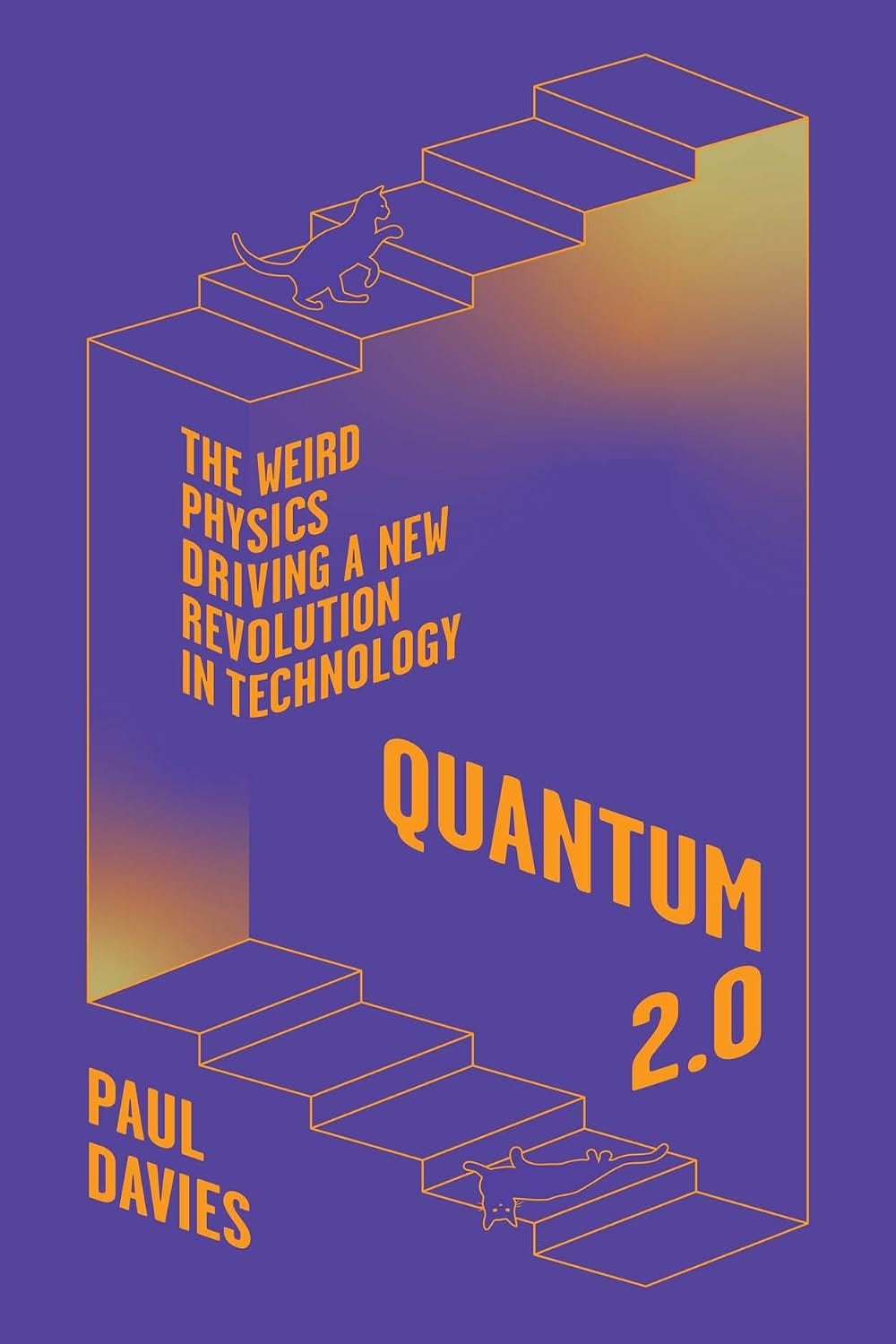

It wouldn’t be wrong to say that this is a book about quantum phenomena that’s particularly well-suited for lawyers and lobbyists. I think it’s a great thing that such a text exists, because those are the sorts of people who ultimately draft most of America’s laws. If they have to write the regulations for it, I think there need to be publicly accessible texts to help them understand it.
Davies makes the core concepts of quantum computing much more accessible to the masses. His book is a great starting point for most people looking to understand what the essential ideas are, what companies like PsiQuantum, Rigetti Computing, and IonQ are building towards, and why their goals might matter not just for shareholders, but for society.
If you’ve got other books about quantum technology applications I should read, please let me know in a comment!